The international bioenergy landscape is entering a critical phase of structural transition. As decarbonization mandates tighten across Europe and global energy systems shift toward renewable frameworks, uniting scientific research with commercial execution has become essential for liquid and solid biofuel supply chains.
To support international communication and market access, Global Biofuel Portal has officially entered into a media partnership with the 5th International Conference & Expo on Biofuels and Bioenergy (Biofuel Expo 2027). Scheduled for June 24–25, 2027, in Berlin, Germany, the event will bring together researchers, fuel producers, technology providers, traders, and policymakers to exchange technical knowledge and discuss industry developments.
The official announcement of this partnership and detailed information regarding event sessions are available at: https://biofuelsconference.org/media-partners/global-biofuel-portal-supports-industry-dialogue-at-biofuel-expo-2027
Global Biofuel Dynamics and Feedstock Diversification
Bridging research and daily trading operations is central to the Berlin agenda. Recent industry metrics reflect this imperative:
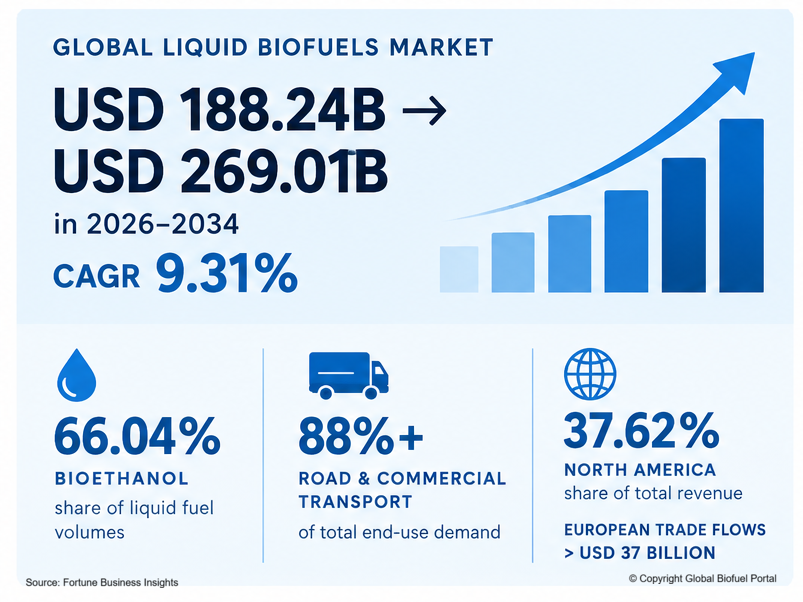
- Market Scaling: The global liquid biofuels market is projected to grow from USD 188.24 billion in 2026 to USD 269.01 billion by 2034, registering a CAGR of 9.31%.
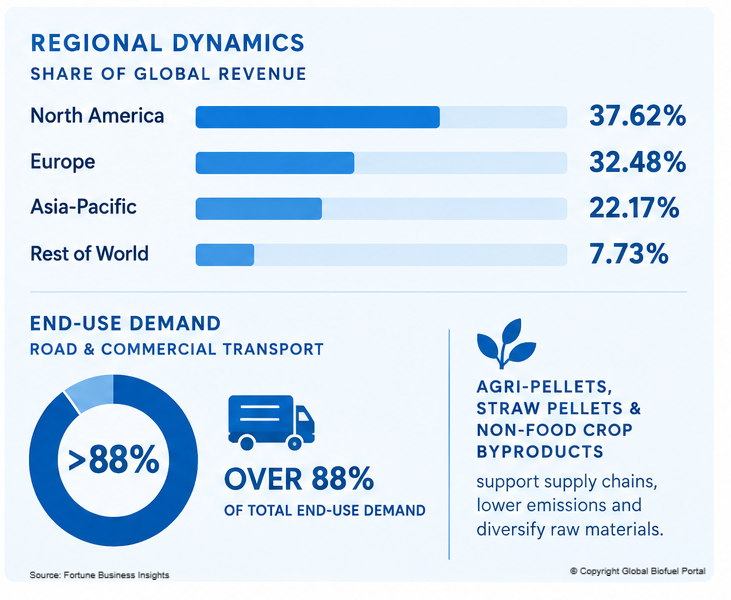
- Fuel Type & Application: Bioethanol continues to dominate liquid fuel volumes with a 66.04% share, while road and commercial transport accounts for over 88% of total end-use demand.
- Regional Dynamics: While North America currently holds a leading 37.62% share of total revenue, European trade flows exceed USD 37 billion as policy mandates accelerate.
Under EU Renewable Energy Directive (RED III) targets and transport decarbonization goals, European demand alone accounts for a major share of global trade flows. Market conditions are also forcing a shift toward secondary and agricultural biomass streams. Agri-pellets, straw pellets, and non-food crop byproducts now play a direct role in balancing supply chains, cutting lifecycle emissions, and diversifying raw material sourcing for power utilities.
Linking Academic Findings with Commercial Supply Chains
Commercial feasibility in the bioenergy sector is decided long before raw materials are processed. Operating margins depend heavily on variables such as feedstock moisture content, calorific yield, transport economics, and international compliance standards.
Through this partnership, Global Biofuel Portal links the scientific proceedings in Berlin with real-world trade logistics. The portal tracks global trade movements, maintains specialized industry directories, and delivers consulting and B2B project support across Europe and Ukraine. By bringing scientific research into direct dialogue with active market participants, this collaboration helps industry stakeholders establish transparent, standardized, and sustainable supply networks.